
Sitemap
A list of all the posts and pages found on the site. For you robots out there is an XML version available for digesting as well.
Pages
Posts
publications
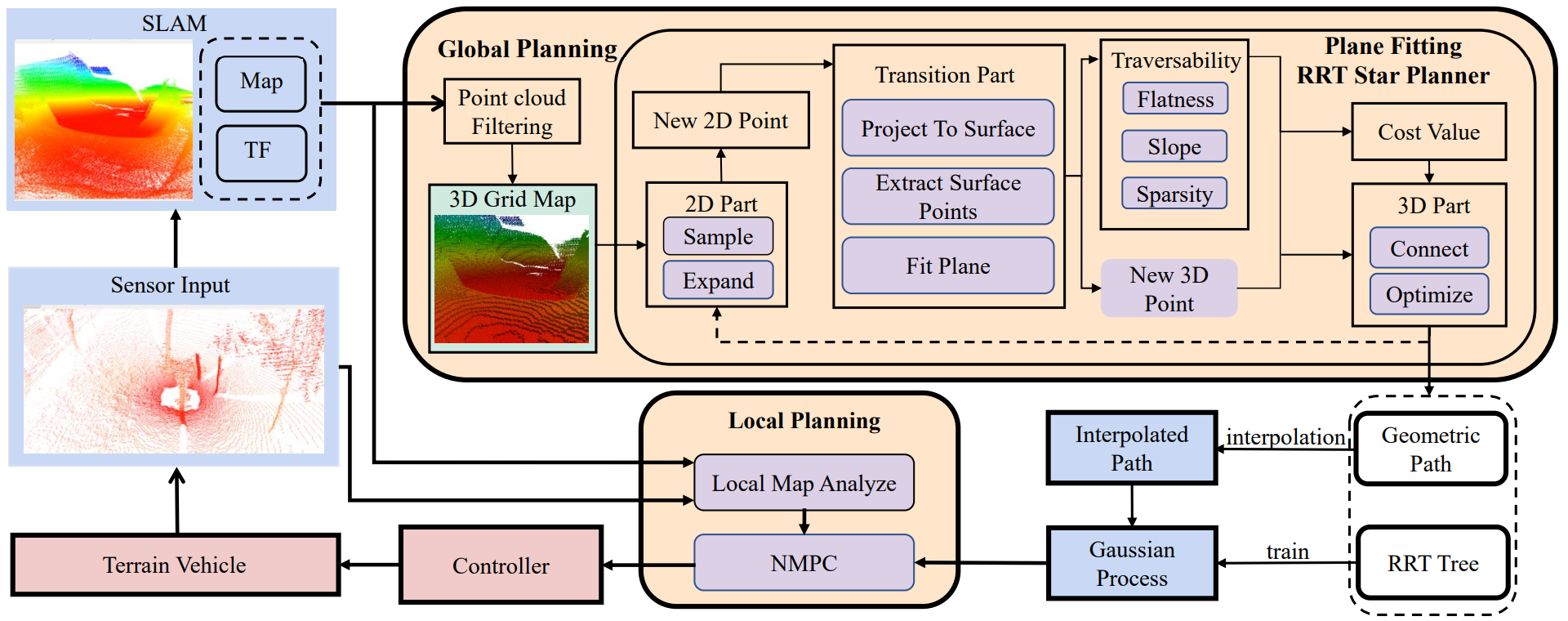
Putn: A plane-fitting based uneven terrain navigation framework
Published in International Conference on Intelligent Robots and Systems (IROS) · IROS 2022. 23 October- 27 October 2022 | Kyoto, Japan, 2022
This paper proposes a Plane-Fitting based Uneven Terrain Navigation (PUTN) framework for autonomous ground robots in unstructured 3D environments. PUTN combines an improved Plane Fitting RRT* for sparse trajectory generation, Gaussian Process Regression for trajectory interpolation, and Nonlinear Model Predictive Control (NMPC) for local planning. Experiments demonstrate PUTN’s robust, safe motion planning in uneven terrain, validated through real-world testing.
Curriculum Proximal Policy Optimization with Stage-Decaying Clipping for Self-Driving at Unsignalized Intersections
Published in The 26th IEEE International Conference on Intelligent Transportation Systems (ITSC). 24 Sep- 28 Sep 2023 | Bilbao, Spain, 2023
This paper proposes a curriculum proximal policy optimization (CPPO) framework with stage-decaying clipping for self-driving at unsignalized intersections. A large clipping parameter enables rapid search for an approximately optimal policy, while a smaller one in later stages ensures convergence. Stage-based curriculum learning and curriculum-specific reward design further improve generalization and accelerate training in intersection-crossing scenarios.
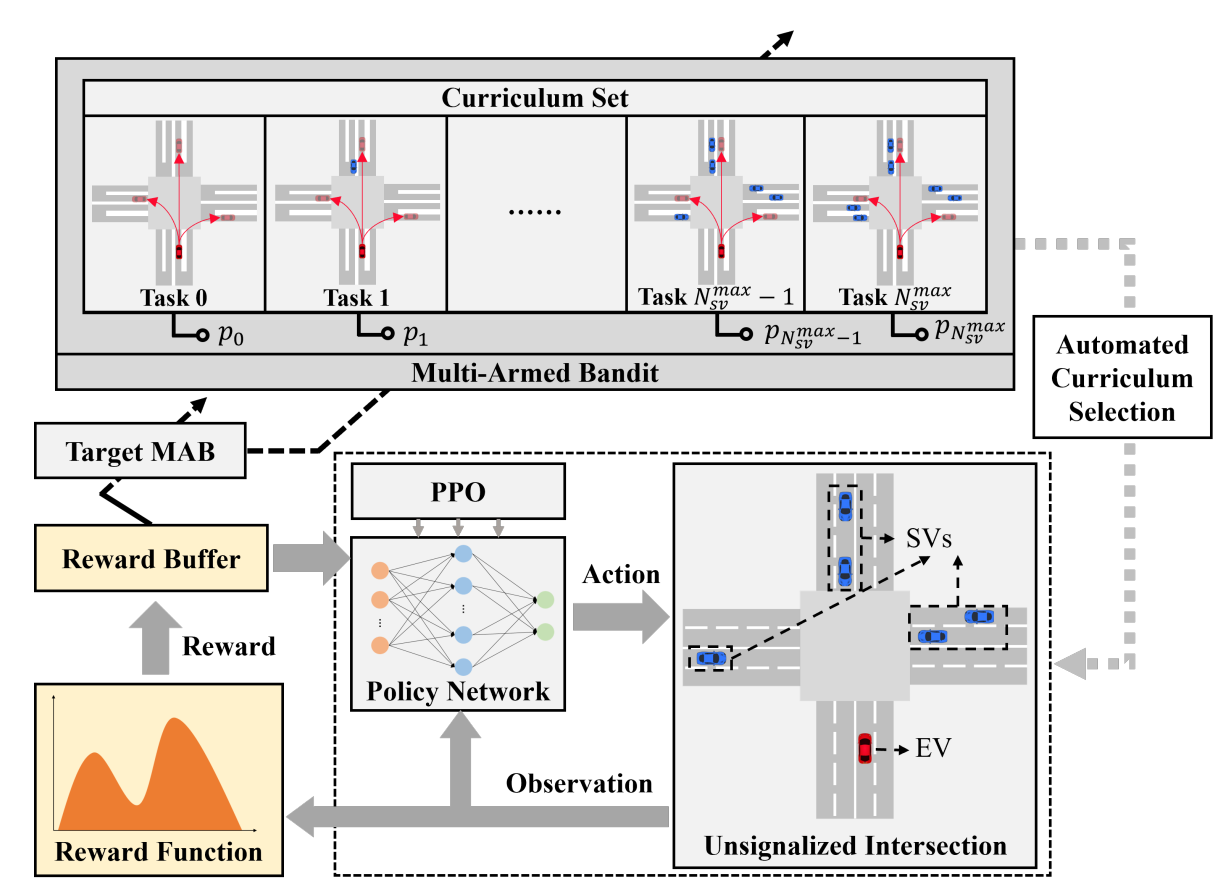
Reward-Driven Automated Curriculum Learning for Interaction-Aware Self-Driving at Unsignalized Intersections
Published in International Conference on Intelligent Robots and Systems (IROS) · IROS 2024. 14 October- 18 October 2024 | Abu Dhabi, UAE, 2024
This paper introduces a reward-driven automated curriculum learning framework for self-driving at unsignalized intersections, addressing uncertainties in surrounding vehicles’ intentions and quantities. A progressive curriculum and well-designed reward function improve policy exploration and sample efficiency. Experiments in Highway-Env and CARLA show superior success rates, robustness, and adaptability, validating the method’s effectiveness in handling complex driving interactions.
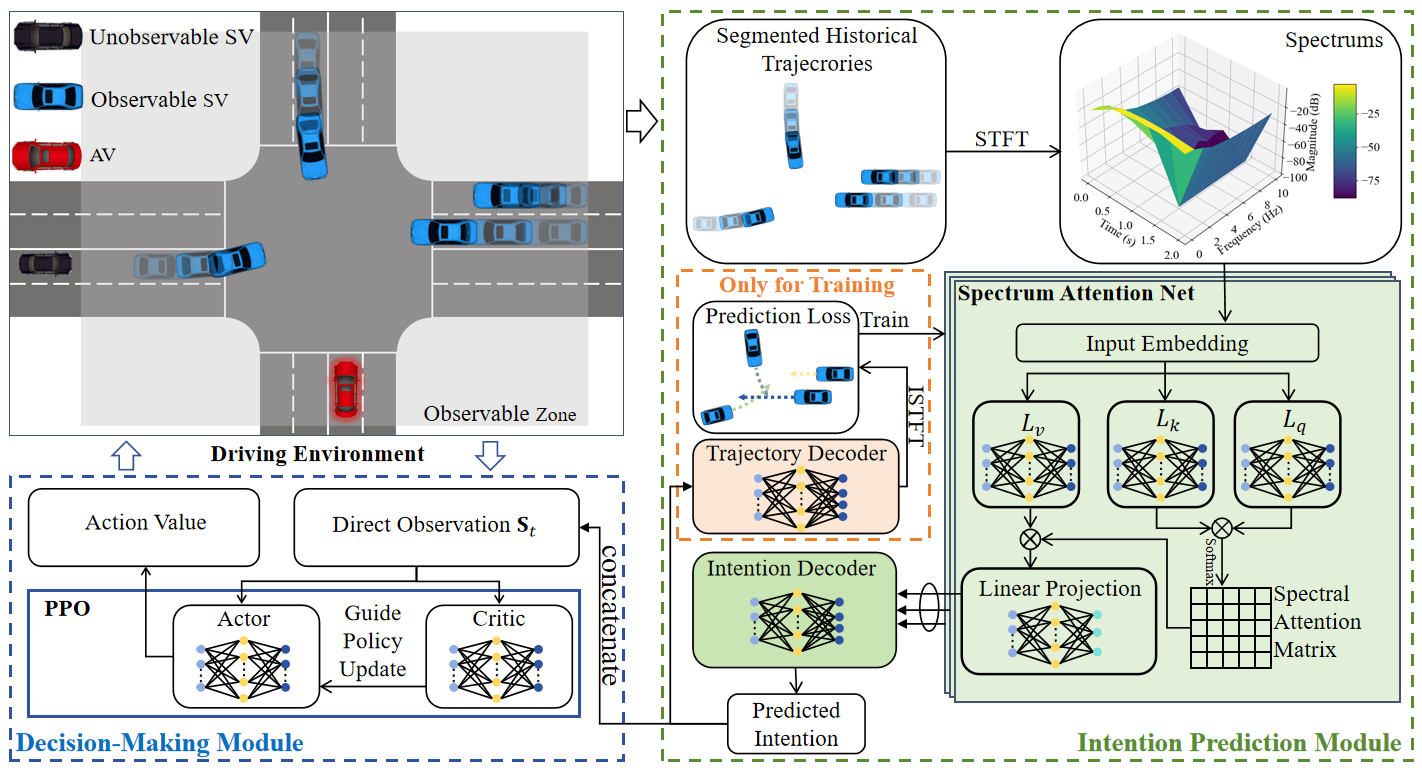
Integrated Intention Prediction and Decision-Making with Spectrum Attention Net and Proximal Policy Optimization
Published in The 27th IEEE International Conference on Intelligent Transportation Systems (ITSC), Oral Presentation. 24 Sep- 27 Sep 2024 | Edmonton, Canada, 2024
This paper presents an integrated intention prediction and decision-making framework for autonomous driving. A spectrum attention net predicts surrounding vehicle intentions efficiently by analyzing frequency components, while the proximal policy optimization (PPO) algorithm addresses non-stationary issues with policy updates. Joint learning integrates both modules, and experiments demonstrate superior performance in safety, efficiency, and success rates compared to deep reinforcement learning baselines.
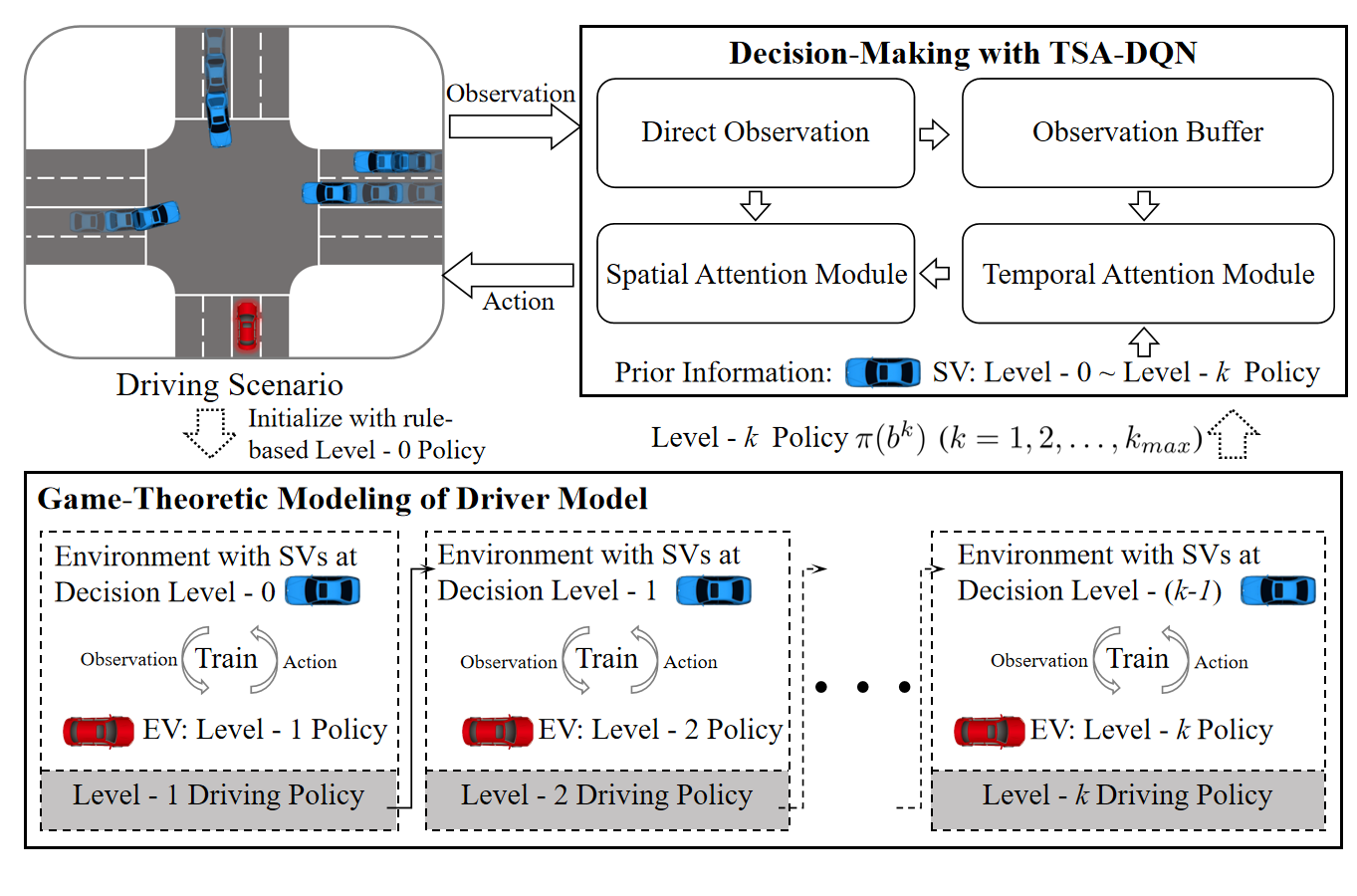
Game-Theoretic Driver Modeling and Decision-Making for Autonomous Driving with Temporal-Spatial Attention-Based Deep Q-Learning
Published in IEEE TRANSACTIONS ON INTELLIGENT VEHICLES, 2024
A game-theoretic driver modeling and decision-making framework with level-k reasoning for autonomous vehicles is proposed. A temporal-spatial attention-based deep Q-learning (TSA-DQN) algorithm is developed to estimate the decision level of surrounding vehicles and optimize ego vehicle’s decision. Simulations demonstrate improved safety, efficiency, and success rates over baselines in various driving scenarios. Real-world testing further confirms the algorithm’s practical feasibility.
Behavioral Uncertainty-Aware Attention Allocation via VLMs for Interactive Autonomous Driving
Published in IEEE TRANSACTIONS ON VEHICULAR TECHNOLOGY, 2026
This paper addresses how an autonomous vehicle with limited onboard computation should allocate attention among surrounding vehicles. The behavioral uncertainty of surrounding drivers is modeled in terms of micro-level cooperativeness and macro-level intentions, and is combined with multimodal scene information and attention memory in a structured prompt, enabling a vision-language model (VLM) to allocate attention to the vehicles that pose genuine threats. Experiments show higher success rates than baselines and improved robustness as traffic density increases.
SocialTraj: Two-Stage Socially-Aware Trajectory Prediction for Autonomous Driving via Conditional Diffusion Model
Published in IEEE TRANSACTIONS ON VEHICULAR TECHNOLOGY, 2026
SocialTraj integrates social value orientation (SVO) into trajectory prediction for autonomous driving. The SVOs of surrounding vehicles are estimated with Bayesian inverse reinforcement learning and embedded into a conditional denoising diffusion model, together with the planned trajectory of the ego vehicle. Experiments on NGSIM and HighD show socially compliant, behaviorally consistent predictions that outperform existing baselines.